How Does Artificial Intelligence Work? A Simple Beginner’s Guide
You unlock your phone with your face. You ask a voice assistant for the weather. A video app suggests exactly the song you wanted to hear next. None of this is magic — it is artificial intelligence (AI) doing its job quietly in the background.
But how does it actually work? If other explanations sounded like a computer science lecture, this guide is for you. We will break AI down into simple pieces and everyday examples.
What Is Artificial Intelligence, in Plain Words?
Artificial intelligence is software that learns patterns from examples and then uses those patterns to make decisions or predictions. A normal program follows fixed instructions written by a person: “if this happens, do that.” An AI program is shown many examples instead, and works out the useful patterns itself.
Think of teaching a child to recognise apples. You would not describe an apple with measurements and colour codes. You would show the child many apples — red, green, big, small — until the child just “gets it.” AI learns in a surprisingly similar way.
The Three Building Blocks: Data, Training, and Models
Almost every AI system you will ever use rests on three simple ideas.
1. Data: the examples
Data is simply information used for learning — photos, sentences, voice recordings, prices, clicks, or almost anything else. For an AI that recognises faces, the data is millions of labelled photos. For a chatbot, it is huge amounts of written text. More good-quality examples usually means a smarter system, just as a student who practises more questions does better in an exam.
2. Training: the learning process
Training is where the AI studies the data. It looks at one example, makes a guess, checks whether the guess was right, and adjusts itself slightly when it is wrong — then repeats this millions of times.
Imagine practising free throws in basketball. You shoot, miss, adjust your aim a little, and shoot again. After thousands of attempts, your hands seem to “know” what to do. Training is that same loop — guess, check, adjust — done at enormous speed.
3. The model: the finished “brain”
After training, the result is called a model — the part that has stored all the patterns it discovered, like the trained student’s brain on exam day. When you give a finished model something new — a photo it has never seen, a question it has never been asked — it uses those patterns to produce an answer. This output is called a prediction, even when it is a full paragraph of text or a generated image.
How AI Learns, Step by Step
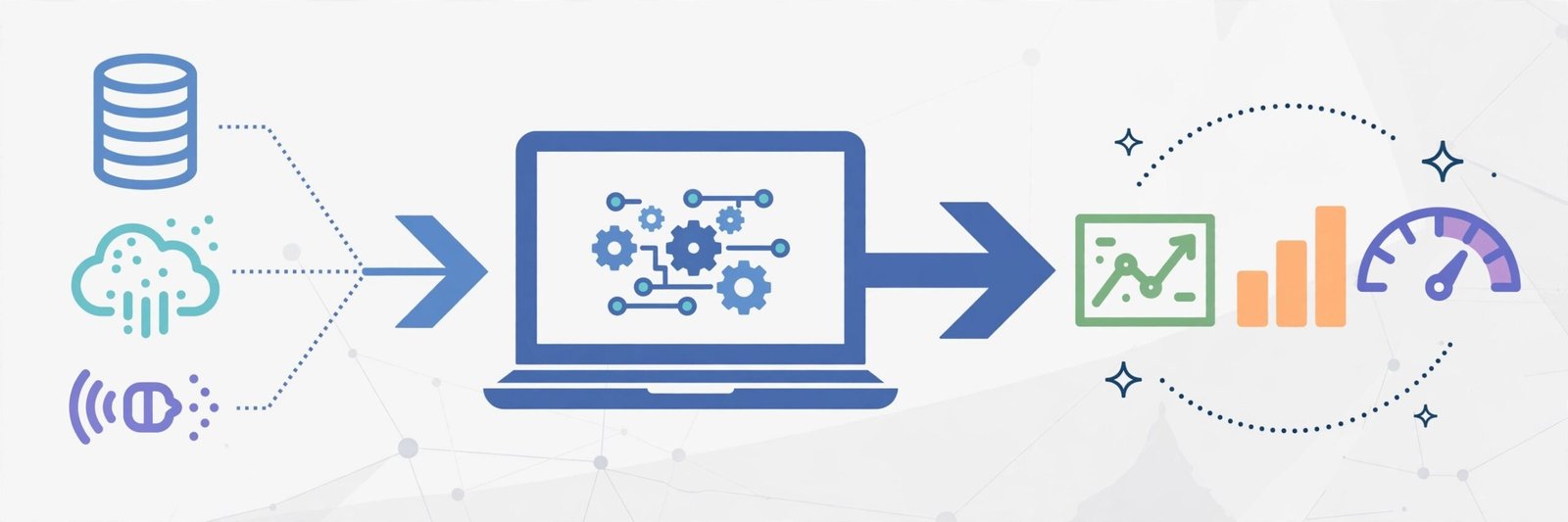
Here is the whole journey in one simple sequence:
- Collect examples. Gather lots of data, such as photos labelled “cat” or “not cat.”
- Feed and guess. Show the system one example and let it guess.
- Score the guess. Compare the guess with the correct answer.
- Adjust. The system nudges its internal settings a tiny bit so it is more likely to be right next time.
- Repeat millions of times. Slowly, the guesses become accurate.
- Use the model. Placed inside an app, it now makes predictions on brand-new information in a fraction of a second.
That adjusting process is the heart of a branch of AI called machine learning. Its more powerful cousin, deep learning, uses large layered networks loosely inspired by how neurons connect in the brain. Just remember: examples in, patterns learned, predictions out.
Real Examples You Already Use
AI is not a future technology. You probably used it several times today.
- Spam filters learned from millions of junk emails, so they can spot a suspicious message you have never seen before.
- Recommendations on video and shopping sites notice what people similar to you enjoyed, and suggest what you might like next.
- Voice assistants were trained on countless hours of speech, turning your words into text and then into actions.
- Maps apps learn from traffic patterns to predict jams and suggest faster routes.
- Photo apps recognise faces, pets, and places, so you can search your gallery for “beach” or “birthday.”
Common Misconceptions About AI
“AI thinks like a human.” Not really. AI finds statistical patterns. It does not understand the world the way you do, and it has no feelings, intentions, or common sense beyond its training data.
“AI is always right.” It is not. If the training data is incomplete or biased, answers can be wrong or unfair — which is why human checking still matters.
“AI will learn anything on its own.” A model only knows patterns from the data it was trained on. Show a face-recognition model a completely new task, like cooking, and it knows nothing about it.
“Chatbots know everything.” Chatbots can sometimes produce confident-sounding but incorrect answers, so always verify important facts.
At YumPlatter, we explain tools like these in plain language, so you can enjoy AI’s benefits without an engineering degree.
Frequently Asked Questions
Is AI the same as a robot?
No. AI is software — the “thinking” part. A robot is a physical machine. Some robots use AI software, but most AI lives in apps and websites with no physical body at all.
What is the difference between AI and machine learning?
Machine learning is one way of building AI — the “learn from examples” method described in this guide. AI is the bigger goal, and machine learning is currently its most successful technique.
Can AI learn after it is released?
Usually, the model you use is mostly fixed once training finishes. Companies retrain their models over time with newer data, then release an improved version.
Does AI need the internet to work?
Not always. Some AI runs in the cloud, while smaller models run directly on your phone — for example, when your keyboard predicts your next word offline.
Is AI dangerous?
AI is a tool, and its impact depends on how people use it. The realistic concerns today are privacy, biased decisions, and fake content — which is why learning how AI works genuinely helps.
Conclusion
So, how does artificial intelligence work? It learns from data during training, stores the patterns it discovers in a model, and uses that model to make fast predictions on new information. Guessing, checking, and adjusting — repeated millions of times — turns simple software into something that feels surprisingly smart.
Once you understand that loop, the mystery disappears. Face unlock, smart replies, and perfect recommendations are all just very well-trained patterns, working quietly for you every day.