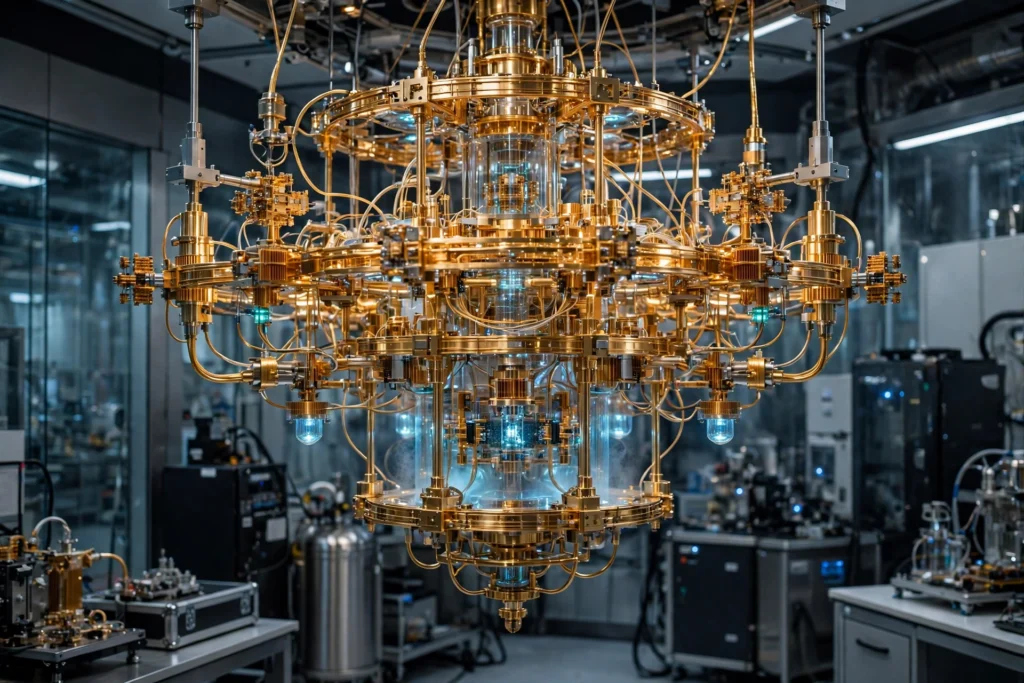

Quantum computing is the technology that makes headlines with words like “breakthrough” and “revolution”, usually followed by a photo of a shiny golden machine that looks like a chandelier. The claims sound like science fiction: computers that solve in minutes what would take normal machines thousands of years. Some of that is real, some of it is hype, and telling the two apart starts with understanding one strange idea.
A normal computer stores information as bits, tiny switches that are either 0 or 1. A quantum computer stores information as qubits, which can be 0, 1, or a strange mix of both at the same time. That mix lets a quantum computer explore many possibilities at once instead of checking them one by one, and for certain problems that is an enormous advantage.
This guide explains quantum computing in plain English: what a qubit is, how these machines actually work, what they are good at, what they cannot do, and when any of it will matter to your daily life.
What a Qubit Is
A bit is simple. It is a 0 or a 1, off or on, like a light switch. Everything your phone and laptop do, from playing a video to sending a message, comes down to billions of bits flipping between those two states. A qubit is the quantum version of a bit, and it behaves very differently.
A qubit can be in a state called superposition, which means it holds a combination of 0 and 1 at the same time. Think of a coin spinning in the air: while it spins, it is neither heads nor tails, but a mix of both, and only when it lands do you get a definite answer. A qubit is like that spinning coin, except you can do maths with it while it spins.
Two qubits can be linked in a way called entanglement. When qubits are entangled, measuring one instantly tells you something about the other, no matter how far apart they are. Einstein famously called this “spooky action at a distance”, and it bothered him for the rest of his life. Today it is a measured, repeatable fact, and it is one of the tools that makes quantum computing work.
The catch is that qubits are fragile. The slightest vibration, temperature change or stray electromagnetic signal can destroy their quantum state, a problem called decoherence. That is why quantum computers live in extreme conditions, colder than outer space, inside vacuum chambers, shielded from the world.
How a Quantum Computer Works
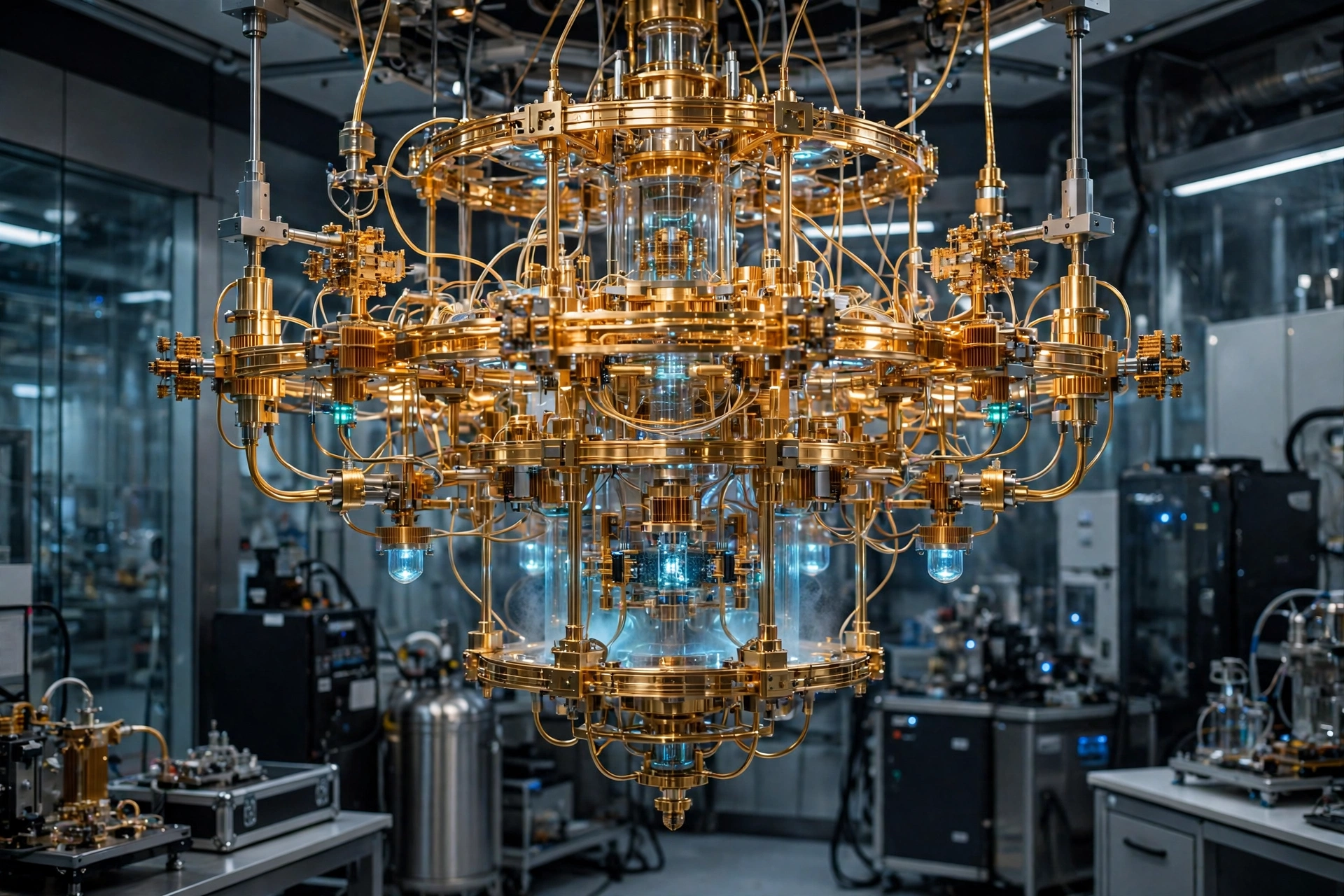
A quantum computer looks nothing like a laptop. The most common design, built by companies like IBM and Google, uses superconducting circuits cooled to about 0.015 Kelvin, which is colder than deep space. At that temperature, the circuits behave quantum mechanically, and engineers can control qubits with precisely timed pulses of microwaves.
Other designs use different tricks. Some trap individual atoms with lasers, others use photons, particles of light, travelling through silicon chips. Each approach has strengths and weaknesses, and nobody knows yet which one will win. What they share is the same basic idea: prepare qubits, entangle them, run a quantum algorithm that explores many possibilities at once, and then measure the result.
Measurement is where the magic ends and the hard work begins. When you measure a qubit, superposition collapses and you get a plain 0 or 1. A quantum algorithm is designed so that the wrong answers cancel each other out and the right answer becomes the most likely result. You run the calculation many times and take the answer that shows up most often. It is less like a calculator giving one exact answer and more like a loaded dice that lands on the right number most of the time.
Today’s machines are small by the standards of the future. The largest quantum computers have around a thousand physical qubits, but many of those are needed just to correct errors, so the number of reliable, useful qubits is far lower. The field calls this the NISQ era, short for noisy intermediate-scale quantum, which is an honest way of saying the machines work, but they are noisy and limited.
Error correction is the key idea to understand here. Because qubits are so fragile, engineers spread one logical qubit, one reliable unit of quantum information, across many physical qubits, so that if a few of them fail, the others can catch the mistake. It works, but it is expensive: a single reliable qubit might need a thousand physical ones. That is why the path to a truly useful quantum computer is measured in millions of physical qubits, not thousands, and why progress feels slow even when the headlines sound dramatic.
Quantum vs Normal Computers
It is tempting to think of a quantum computer as a faster version of a normal one. It is not. A quantum computer is a different kind of machine, brilliant at a few specific problems and useless at most everyday tasks. It will never be better at loading a website, editing a video or running a spreadsheet, and nobody is trying to make it do those things.
Normal computers are unbeatable at tasks with clear, step-by-step rules. Quantum computers shine at problems where the number of possibilities explodes as the problem grows: finding the best arrangement among billions of options, simulating molecules, or factoring very large numbers. For those problems, a quantum computer can explore many paths at once, while a normal computer must walk them one by one.
Google made headlines in 2019 when its Sycamore processor finished a specific calculation in about three minutes that the company estimated would take a supercomputer thousands of years. That result, called quantum supremacy, was a real milestone, but the calculation itself had no practical use. It proved the hardware could do something no normal machine could, which is exactly the point of a milestone.
| Feature | Normal Computer | Quantum Computer |
|---|---|---|
| Basic unit | Bit (0 or 1) | Qubit (0, 1, or both) |
| Best at | Everyday tasks, clear rules | Optimisation, simulation, factoring |
| Operating temperature | Room temperature | Near absolute zero |
| Size | Phone to data centre | Large, specialised lab machine |
| Availability | Everywhere | Cloud access, few machines |
What Quantum Computers Could Do
Drug discovery is the most promising use. Designing a new medicine means understanding how molecules behave, and molecules are quantum systems. Normal computers approximate that behaviour, which is slow and imprecise. A quantum computer could simulate molecules accurately, helping scientists find new drugs faster and with fewer dead ends. This is still years away, but it is the application researchers talk about most.
Materials science is closely related. Better batteries, more efficient fertilisers and new superconductors all depend on understanding materials at the atomic level. A quantum simulation could reveal materials that normal computers cannot model, which would matter for electric cars, clean energy and electronics.
Optimisation is a third area. Airlines, shipping companies and banks all face problems with millions of possible combinations: the best routes, the best schedules, the best portfolios. Quantum algorithms could find better answers to these problems than current methods, saving fuel, time and money. Early experiments with real companies are already running, though the results are modest so far.
Finance is a close cousin of optimisation. Banks use quantum experiments to price complex financial products, assess risk across huge portfolios and detect fraud patterns hidden in mountains of transactions. The sums involved are enormous, so even a small improvement in accuracy is worth a lot of money. A few large banks already run pilot projects on cloud quantum machines, testing whether quantum methods beat their current models on real data. The results are early and mixed, but the investment tells you how seriously the industry takes the possibility.
Cryptography is the use that worries governments. Much of today’s internet security relies on the fact that factoring large numbers is practically impossible for normal computers. A powerful enough quantum computer could break that maths, which is why security agencies and tech companies are already working on quantum-resistant encryption. The threat is real but not immediate: breaking current encryption would need a machine far larger than anything built today, and experts disagree on whether that will take ten years or thirty. If you want to understand the AI side of the tech world too, our How Does Artificial Intelligence Work? (A Simple Beginner’s Guide) explains it in the same plain style.
The Algorithms That Make It Work
A quantum computer is only as useful as the algorithms written for it, and a few famous ones show what the machines can do. Shor’s algorithm, published by mathematician Peter Shor in 1994, can factor large numbers far faster than any known normal method. It is the algorithm behind the encryption worries, because the security of much of the internet rests on factoring being hard. A large enough quantum computer running Shor’s algorithm could break RSA encryption, which protects everything from bank logins to government secrets.
Grover’s algorithm, published in 1996, takes a different approach: it searches an unsorted database faster than a normal computer can, cutting the time roughly to the square root of the normal time. That sounds abstract, but it applies to many search and optimisation problems, from finding the best delivery route to cracking weak passwords. It is less dramatic than Shor’s algorithm, but it is more broadly useful.
Quantum simulation algorithms are the third group, and they may matter most. Simulating a molecule means tracking how its electrons behave, and the number of possibilities grows so fast that normal computers can only handle small molecules. A quantum computer, built from quantum parts, can model those electrons naturally. Chemists have already simulated small molecules like hydrogen and lithium hydride on real quantum hardware, and each step up in size opens new possibilities for drug and material design.
The Limits and Problems
Error rates are the biggest problem. Qubits are so fragile that calculations go wrong constantly, and fixing those errors takes many extra qubits. Researchers estimate that a truly useful, fault-tolerant quantum computer might need a million physical qubits, against roughly a thousand today. Closing that gap is the central challenge of the whole field, and nobody can say exactly how long it will take.
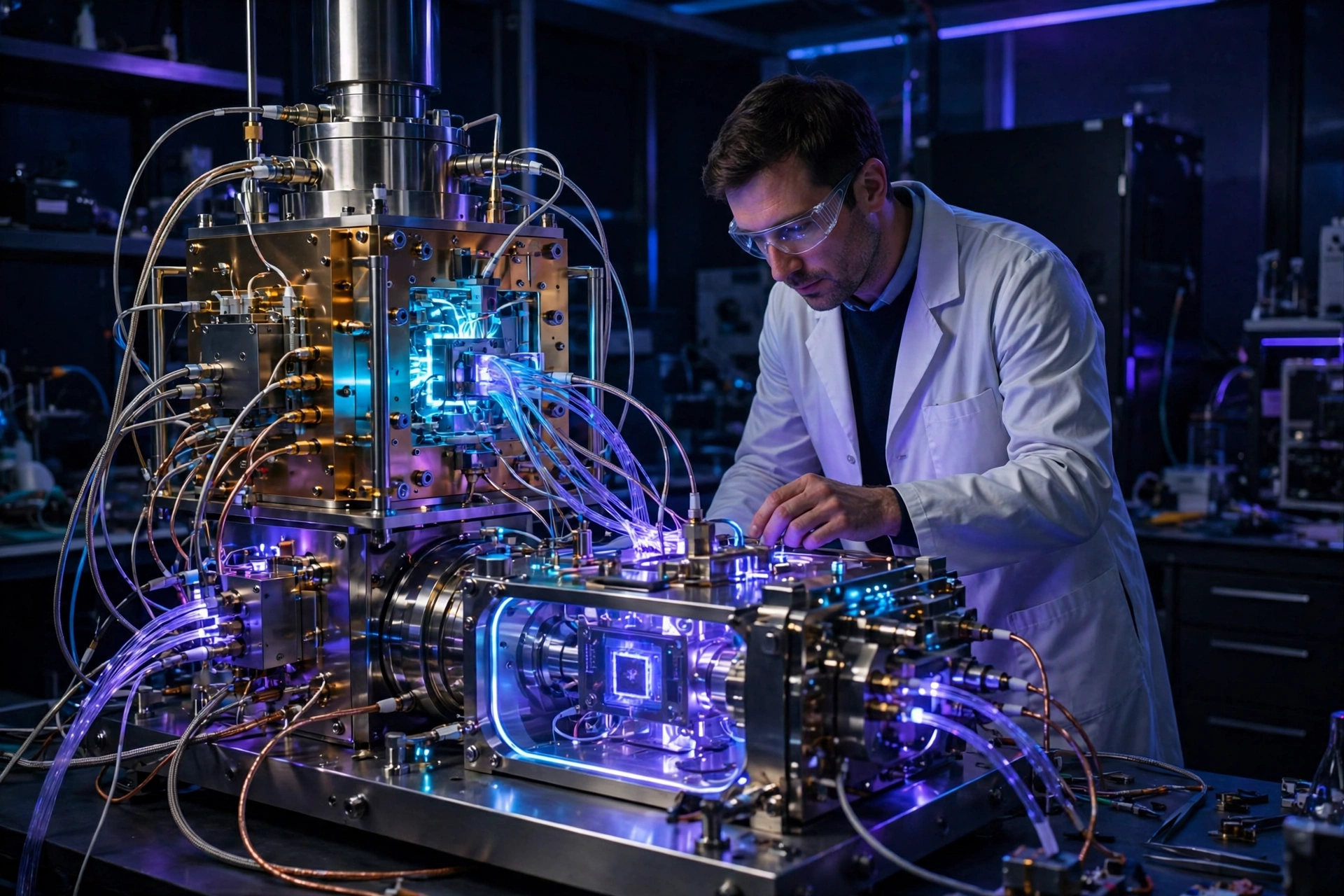
Cost is another barrier. A quantum computer costs millions of dollars to build and run, needs specialised cooling and shielding, and needs a team of physicists to keep it working. That is why almost nobody owns one: companies like IBM, Google and Amazon offer access through the cloud, where researchers and businesses rent time on a shared machine.
The software side is just as young. There are far fewer quantum programmers than normal programmers, and writing a quantum algorithm is a different skill from writing an app. The tools are improving, with frameworks like Qiskit and Cirq making it easier to experiment, but the field is still closer to the early days of computing than to the mature software world.
Finally, there is the hype problem. Every small advance gets announced as a revolution, and investors pour money into startups that promise the moon. Some of that excitement is justified, but quantum computing will not replace your laptop, fix the climate or cure disease on its own. It is a powerful new tool for specific problems, and it will arrive gradually, not all at once.
When Will It Matter to You?
For most people, the honest answer is: not for years, and then indirectly. You will not buy a quantum laptop or a quantum phone. What you will see is better medicines, better batteries and better materials that were designed with the help of quantum computers, and stronger encryption that protects your data against future quantum attacks.
If you work in science, finance or logistics, the timeline is closer. Cloud access to quantum machines is available today, and companies are already testing quantum algorithms on real problems, even if the results are early. Learning the basics now puts you ahead of the curve, and free courses from IBM and others make that easy.
There is also a career angle worth noting. Quantum computing needs physicists, but it also needs software engineers, mathematicians, chemists and materials scientists, and the field is small enough that a motivated beginner can still make a real contribution. Universities are adding quantum courses every year, and the big tech companies run summer schools and internships aimed at students with no prior background. If the field interests you, the best time to start learning was a few years ago, and the second best time is now.
Students and the curious can try a real quantum computer from a browser. IBM’s cloud platform lets anyone run small experiments on actual hardware for free, which is a remarkable thing: a decade ago, touching a quantum computer required a physics lab and a security badge. Today it takes an email address. If you are a student building skills for the future, our Best AI Tools for Students (Study Smarter, Not Harder in 2026) is a good companion read.
FAQ
Will a quantum computer replace my laptop?
No. Quantum computers are built for a small set of specialised problems, like simulating molecules and optimising huge systems. They are worse than a laptop at everyday tasks like browsing, email and video, and they always will be. The two kinds of computer will work side by side.
How fast is a quantum computer really?
For the right problem, enormously fast: Google’s Sycamore chip did a test calculation in minutes that would take a supercomputer thousands of years. For most problems, it is no faster at all, and often slower. Speed depends entirely on whether the problem suits quantum methods.
Can quantum computers break all encryption?
Not yet, and not for a long time. Breaking today’s encryption would need a large, error-corrected quantum computer that does not exist yet. Security experts are already building quantum-resistant encryption, and the transition is expected to take years. Your passwords and bank logins are safe for now, but keeping them strong still matters, so see the Best Password Managers (Keep Every Login Safe in 2026).
Do I need physics to learn quantum computing?
It helps, but you can start without it. Many beginner courses explain qubits and quantum algorithms with pictures and analogies, and you can run experiments on cloud quantum computers with no physics background. A basic grasp of linear algebra becomes useful later, but it is not needed to understand the ideas.
Who is leading the quantum race?
IBM, Google, Microsoft and Amazon lead on the commercial side, alongside startups like IonQ and Rigetti. China invests heavily through state programmes, and Europe, Japan and Canada all have serious national efforts. It is a global race with no clear winner yet, and different teams bet on different hardware designs.
Conclusion
Quantum computing uses qubits, superposition and entanglement to explore many possibilities at once, which makes it powerful for specific problems like drug discovery, materials science and optimisation. Today’s machines are small, noisy and expensive, and they live in extreme cold, accessed mostly through the cloud. They will not replace your laptop, and they will not break all encryption tomorrow. But the science is real, the progress is steady, and the day a fault-tolerant quantum computer arrives will change what science and industry can do. Understanding the basics now means you will recognise that day when it comes, instead of mistaking the next press release for it.