

You have probably seen “5G” printed on phone boxes, adverts and network shop windows for years now. It promises faster downloads, smoother video and a future full of self-driving cars and smart cities. But what does it actually do, and does it change anything about how you use your phone today? The short answer is yes, but not always in the ways the adverts suggest.
5G is the fifth generation of mobile network technology, the successor to 4G LTE. It is not one single invention but a set of new radio technologies, network designs and frequency bands that work together to carry far more data, far faster, with far less delay. By 2026, 5G covers most cities and large towns in the United States, Europe and much of Asia, and most new phones support it.
This guide explains 5G in plain English: how it works, how it compares with 4G, where you already use it without noticing, and what its real limits are. No engineering degree needed.
What 5G Actually Is
Every mobile network generation has been defined by what it made possible. 1G gave us voice calls, 2G added texting, 3G brought the mobile internet, and 4G made video streaming and apps work properly. 5G is built for a world where everything is connected: phones, cars, watches, cameras, factory machines and millions of sensors.
Technically, 5G is a standard created by the 3GPP, the global body that writes mobile network rules, and the version most networks run today is called 5G NR, or New Radio. It uses new radio frequencies, smarter antennas and a redesigned network core to move data more efficiently than 4G ever could. The first commercial 5G networks launched in 2019, in South Korea and the United States, and coverage has spread steadily since.
The key point is that 5G is not just “faster 4G”. It changes three things at once: speed, delay and capacity. Speed is the headline, but the other two matter more for the future uses, like remote surgery and autonomous vehicles, that 4G could never handle reliably.
How It Works
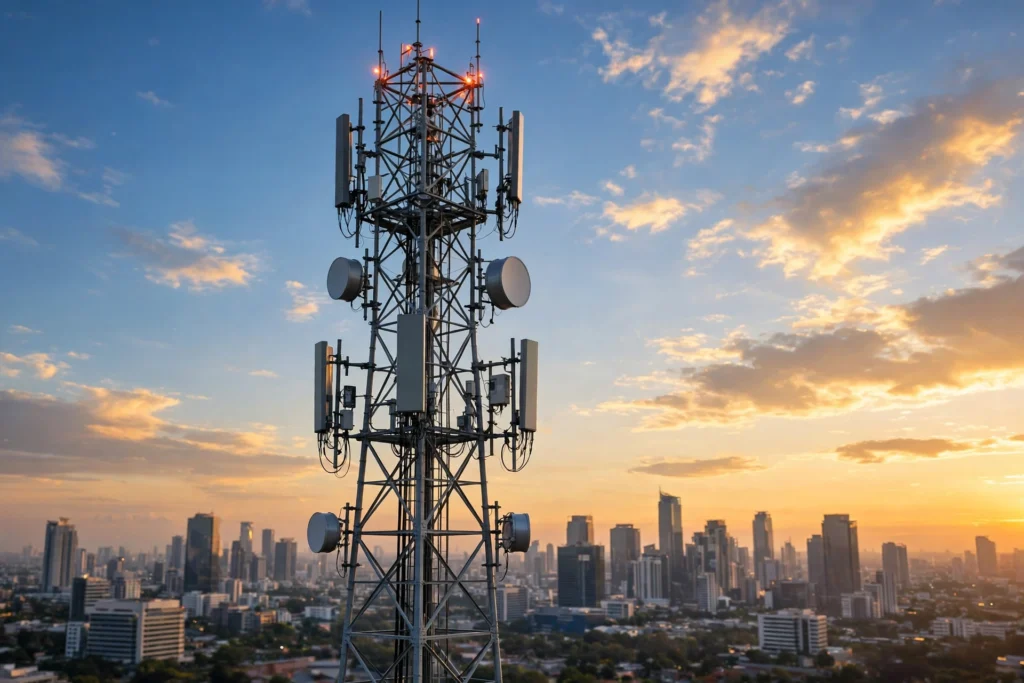
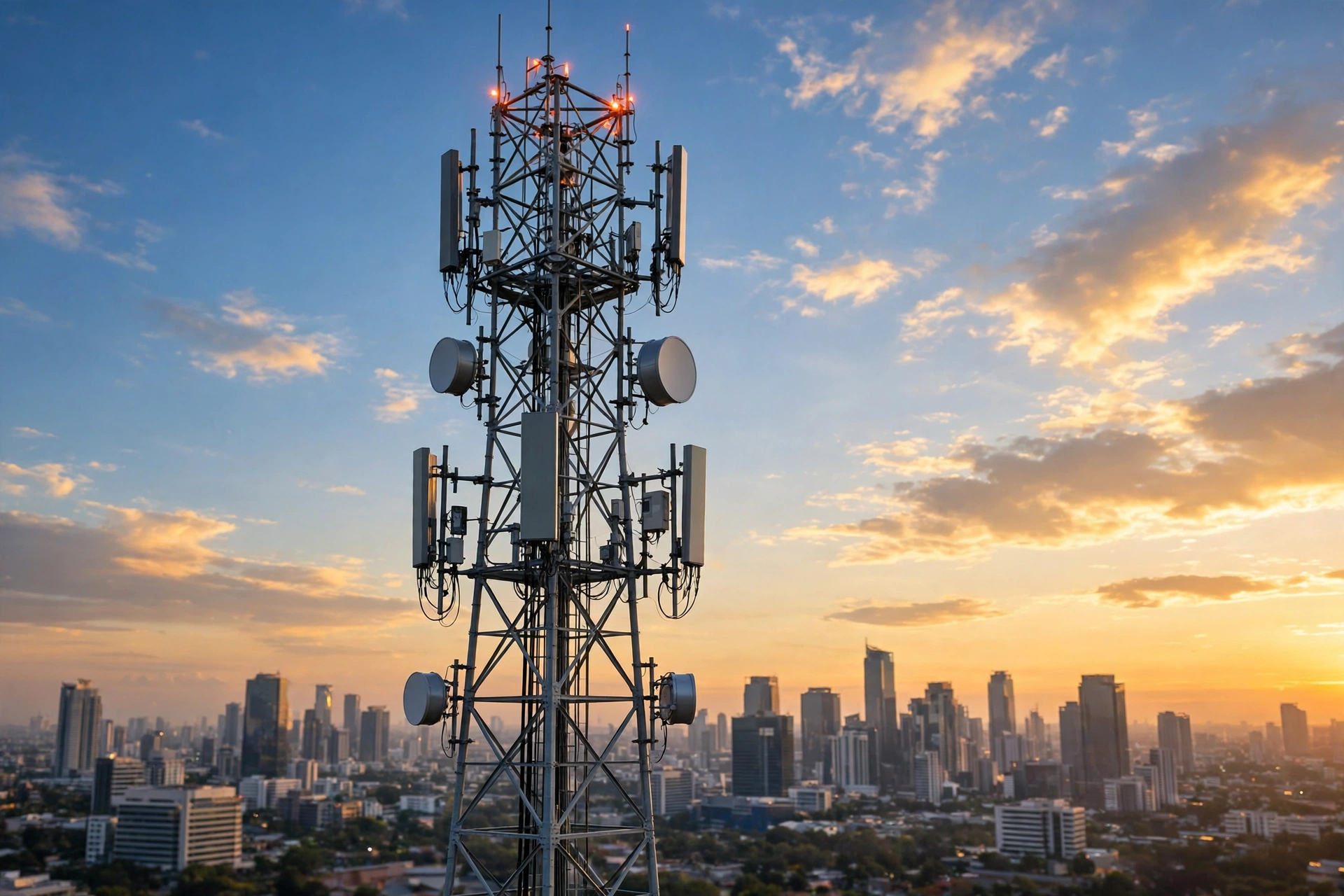
Your phone talks to a nearby cell tower using radio waves, and 5G improves that conversation in three ways. First, it uses new frequency bands. Low-band 5G travels far and passes through walls, much like 4G, but is only a little faster. Mid-band 5G is the sweet spot, offering a big speed jump with decent range, and it is what most people actually use. High-band 5G, also called mmWave, is extremely fast but only travels a few hundred metres and struggles with walls, so you mostly find it in stadiums, airports and busy city centres.
Second, 5G uses massive MIMO antennas, which is a fancy way of saying the tower has dozens of small antennas working together instead of a few big ones. These antennas can aim signals directly at your phone, a trick called beamforming, instead of spraying signal in all directions. That means less interference, stronger connections and more users served at once.
Third, 5G networks can be “sliced”. Network slicing lets a carrier split one physical network into virtual slices, each tuned for a different job. One slice can give a hospital’s connected devices ultra-reliable low delay, while another gives a stadium full of fans maximum download speed. 4G could not do this, and it is one of the reasons industries are excited about 5G.
The network core changed too. Older mobile networks ran on specialised hardware in each carrier’s data centres, while 5G cores are built on software that runs on ordinary cloud servers. That sounds like a small detail, but it means carriers can update, scale and repair their networks far faster than before, and it is what makes features like slicing practical in the first place. The radio towers you see are only half the story; the software behind them is the other half.
5G vs 4G: The Real Differences
Speed is the difference people notice first. A good 4G connection delivers around 20 to 50 Mbps in real life, while mid-band 5G commonly delivers 100 to 300 Mbps, and mmWave can pass 1 Gbps in ideal conditions. That means a two-hour film in HD downloads in under a minute on fast 5G, against several minutes on 4G.
Latency, the delay between tapping something and the network responding, is where 5G pulls further ahead. 4G latency is usually 30 to 50 milliseconds, while 5G can get under 10 milliseconds on a good network, and under 5 milliseconds in private industrial setups. That sounds small, but it is the difference between a video call that feels instant and one that talks over itself, and it matters hugely for gaming and remote control of machines.
Capacity is the third difference. 5G can handle around a million connected devices per square kilometre, against roughly a hundred thousand for 4G. That is why 5G matters for smart cities and factories full of sensors, not just for phones. For a quick comparison of the networks and devices around you, see our roundup of Internet of Things Examples (12 Smart Devices Already Around You).
| Feature | 4G LTE | 5G |
|---|---|---|
| Typical download speed | 20–50 Mbps | 100–300 Mbps (mid-band) |
| Peak speed | Around 150 Mbps | Over 1 Gbps (mmWave) |
| Latency | 30–50 ms | Under 10 ms |
| Devices per sq km | Around 100,000 | Up to 1,000,000 |
| Best for | Video and apps | Video, gaming, IoT, industry |
Where You Already Use It
If you bought a phone in the last two or three years, you probably use 5G every day without thinking about it. The most visible benefit is video: streaming in 4K on a train, joining a video call from a park, or uploading a long video to social media all feel smoother on 5G, because the connection holds up better when the network is busy.
Mobile gaming is another real use. Cloud gaming services stream the game from a server, and low latency is what makes the controls feel responsive instead of laggy. 5G makes cloud gaming work on a phone in a way 4G struggled with, especially on the move.
At home, 5G home internet is growing fast. Some carriers now sell a small router that uses 5G instead of a cable or fibre line, giving households a simple plug-in internet option with no engineer visit. It is not faster than good fibre, but in areas with poor wired internet it can be a genuine improvement. It is not faster than good fibre, but in areas with poor wired internet it can be a genuine improvement — and a fast browser helps too, as our Best Web Browsers for PC (Speed, Privacy, and Features Compared in 2026) guide shows.
How 5G Rolled Out Around the World
South Korea switched on the first commercial 5G networks in April 2019, with the United States following days later, and the rollout since then has been steady rather than sudden. China built the largest 5G network in the world, with millions of base stations covering its cities, while Europe moved more slowly, with each country auctioning spectrum and approving equipment at its own pace. By 2024, most major cities on every continent had some form of 5G, though the speed of the service varied wildly from place to place.
The rollout was shaped by politics as much as technology. Governments argued over which companies could supply the equipment, with some countries banning certain vendors over security concerns, and spectrum auctions raised billions for national treasuries. Those debates slowed things down in some regions and sped them up in others, which is why two neighbouring countries can have very different 5G coverage today.
For users, the practical result is that 5G arrived first in cities and is still spreading outward. Suburbs and large towns got coverage next, and rural areas are last in line, because the economics of building towers for a small number of users are harder. Satellite internet and fixed wireless are filling some of those gaps, but a farmhouse with fast 5G is still the exception rather than the rule in most countries.
The Downsides
5G is not magic, and the honest picture includes real limits. Coverage is the biggest one. Low-band 5G is widespread, but the fast mid-band and mmWave versions are still mostly a city thing. Step outside a covered area and your phone quietly drops back to 4G, and you may not even notice the switch.
Battery life is another issue. Early 5G phones drained noticeably faster on 5G than on 4G, because the modem worked harder and searched for signal more often. Newer phones and networks have improved this a lot, but 5G still uses more power than 4G in weak-signal areas, which is one reason some phones switch to 4G automatically when the screen is off.
There is also the cost question. 5G plans and phones cost more than their 4G equivalents did a few years ago, though the gap has shrunk as 5G became standard. And for many everyday tasks, checking email, scrolling social media, messaging friends, 5G feels exactly the same as 4G, because those tasks never needed more speed in the first place.
Health worries come up a lot online, and they deserve a straight answer: major health bodies, including the World Health Organization, have found no evidence that 5G radio waves harm human health at the levels used by mobile networks. 5G uses non-ionising radiation, the same kind as Wi-Fi and FM radio, and it sits far below the limits set by international safety guidelines.
What 5G Makes Possible Next
The most interesting uses of 5G are not about phones at all. In factories, private 5G networks connect robots and sensors with near-zero delay, letting machines coordinate in real time. In ports and warehouses, the same technology tracks containers and guides driverless vehicles. In hospitals, surgeons have already carried out remote operations over 5G, with a specialist controlling instruments from another city.
Self-driving cars are another big one. A car needs to talk to other cars, traffic lights and the road itself within milliseconds, and only a low-latency network can do that reliably. 5G is not the only piece of that puzzle, but it is an important one, and the same logic applies to drones, smart grids and emergency services.
Augmented reality is the consumer use to watch. Lightweight AR glasses need heavy computing done elsewhere and streamed to the wearer instantly, and 5G’s speed and low delay make that possible. The first AR products are still early, but the network they need is already being built. For a broader look at where tech is heading, our Technology Trends 2026 (10 Trends That Will Shape Everyday Life) covers the trends that matter most.
Live events are another place where 5G is already visible. Stadiums now offer multi-angle replays streamed to fans’ phones, with almost no delay, and broadcasters use 5G cameras that replace heavy cabling and outside broadcast trucks. At large festivals and sports events, the network handles tens of thousands of people uploading photos and video at once, something 4G struggled with badly. The experience for the fan is simple: the video works, the replays are instant, and the connection does not collapse at half time.
Do You Need 5G Right Now?
If you are buying a new phone, yes, get one with 5G, because it costs little extra now and it future-proofs the device for years. If your current phone is 4G-only and works fine, there is no rush to upgrade purely for 5G. The everyday difference is real but modest, and it depends heavily on where you live.
Check your carrier’s coverage map for your home, your workplace and your commute before you pay extra for a 5G plan. If you live in a city with mid-band coverage, you will feel the difference in downloads and video. If you live somewhere rural, 5G may add little over 4G for now, and the money is better spent on a better phone or a faster home connection.
One practical tip: if your phone shows 5G but feels slow, the network may be congested or you may be on low-band 5G, which is barely faster than 4G. Restarting the phone or toggling aeroplane mode forces a fresh connection, and that alone fixes a surprising number of slow-data complaints.
It is also worth checking whether your plan actually includes 5G at full speed. Some cheaper plans include 5G but cap the speed, or limit how much high-speed data you get each month before slowing you down. The phone will still show the 5G icon, but the speed will feel like 4G or worse. If your speeds never seem to match what 5G promises, look at the small print on your plan before you blame the network.

FAQ
Is 5G faster than home Wi-Fi?
Sometimes. Fast mmWave 5G can beat older home Wi-Fi, but good fibre broadband with modern Wi-Fi 6 is usually faster and more stable than mobile 5G. 5G wins on convenience and mobility, while home fibre wins for raw speed and consistency.
Does 5G use more battery than 4G?
Yes, usually a little more, especially in weak-signal areas where the phone works harder to hold the connection. Newer phones manage this better, and most let you set 5G to switch on only when it helps.
Do I need a new SIM card for 5G?
Usually not. Most carriers activate 5G on your existing SIM once you have a 5G phone and a plan that includes it. A few older SIMs need replacing, and your carrier will tell you if that is the case.
Your phone will also use 5G automatically when it is available, and fall back to 4G when it is not, so there is nothing to switch on or off in daily use. If you travel abroad, check whether your plan includes 5G roaming, because some cheaper plans limit you to 4G speeds outside your home country, even on a 5G phone in a 5G area.
Is 5G available everywhere?
No. Coverage is strong in cities and large towns in most developed countries, but rural areas often have little or no 5G yet. Low-band 5G reaches further than the fast versions, so coverage maps can look generous while real-world speeds vary a lot by location.
Will 5G replace Wi-Fi?
Not any time soon. Wi-Fi is cheaper, faster indoors and better for connecting many devices at home. 5G is best for mobile use and places without good wired internet. The two work side by side, and most homes will keep both for years to come.
Conclusion
5G is the fifth generation of mobile networks, and it brings three real improvements over 4G: much faster downloads, far lower delay, and room for far more connected devices. The speed is nice for video and downloads, but the low delay and huge capacity are what make 5G important for gaming, industry, healthcare and the connected devices filling our homes. Coverage and battery life are still catching up, and for everyday tasks like messaging and email you may not notice a difference at all. But if you are buying a new phone, 5G is worth having, and as coverage spreads, the gap between what 5G promises and what it delivers keeps shrinking.