

A smart speaker is the easiest way into a smart home. You plug it in, connect it to Wi-Fi, and suddenly you can play music with your voice, set timers while your hands are covered in flour, ask about the weather, and control your lights without touching a switch. No hub, no wiring, no technical setup.
The market has settled into three clear camps: Amazon’s Alexa speakers, Google’s Nest speakers, and Apple’s HomePod line, with Sonos offering a premium option that plays nicely with more than one of them. Picking the wrong camp matters, because the speaker you buy decides which voice assistant you live with — and switching later means replacing the hardware.
This guide compares 7 speakers that are actually worth buying in 2026, from small budget options under $50 to premium models that can anchor a living-room sound system. Prices below are approximate ranges, since all of these go on sale regularly — especially around holidays — so check the current price before you buy.
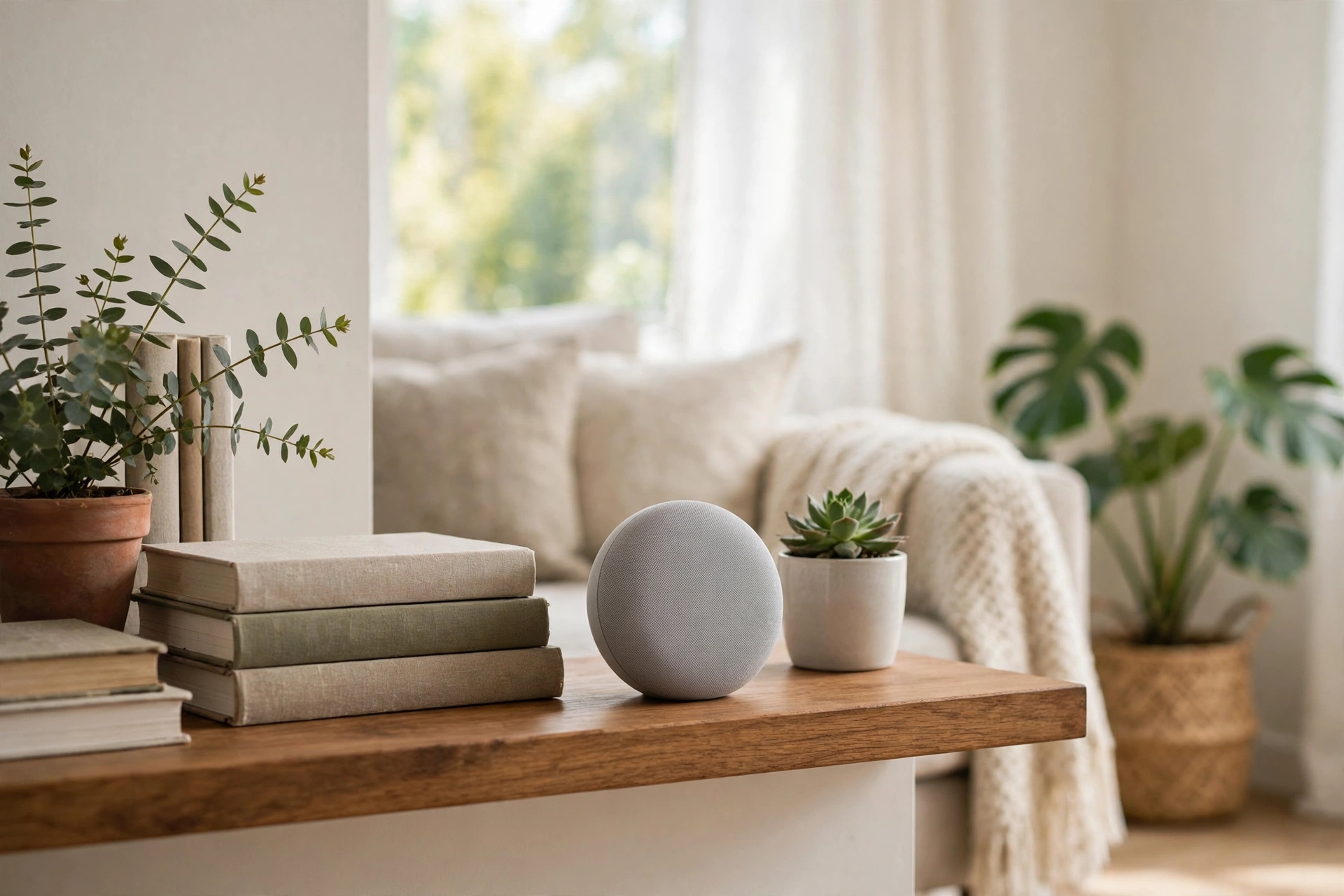
How to Choose a Smart Speaker
Start with the voice assistant, not the speaker. If your household already uses Alexa — for shopping lists, smart plugs, or an existing Echo — another Alexa speaker fits in without friction. If your family lives on Google services, with Android phones and a Google calendar, a Nest speaker makes more sense. And if you’re deep in the Apple world, with iPhones and a HomeKit setup, a HomePod is the natural fit.
Next, think about sound. A small speaker is fine for a bedroom or a kitchen, where you mostly want voice answers, timers, and background music. A living room deserves something bigger, with real bass and room-filling volume. If you already own good speakers, consider a model with an audio output or one that can pair with your existing setup.
Finally, think about privacy. Smart speakers listen for a wake word, and they record what you say after it. All three major platforms let you review and delete your voice recordings, and they all have a physical microphone-off button. Use it when you want guaranteed silence, and check the privacy settings when you first set the speaker up. For a beginner-friendly overview of the smart home world these speakers belong to, see our Smart Home Technology for Beginners (What It Is and Where to Start).
1. Amazon Echo (5th Gen) — Best All-Round Smart Speaker
The standard Echo is the default smart speaker for most homes, and it’s easy to see why. It’s compact enough for a shelf, sounds noticeably better than the tiny Dot, and costs around $100 at full price — often much less on sale. Alexa handles the usual jobs well: music, timers, weather, shopping lists, and controlling smart home devices, with one of the largest selections of compatible gadgets of any platform.
Sound quality is solid for the size, with a clear mid-range and decent bass for a speaker this small. You can pair two Echos in stereo, or add an Echo Sub if you want more low end. The 5th generation adds a temperature sensor and better sound processing than the model it replaced, and it works as a hub for Zigbee and Matter smart home devices, so you can connect compatible gadgets without a separate hub.
The main downside is the same as Alexa’s main strength: Amazon’s ecosystem. If you don’t want Amazon’s shopping and services woven through your speaker, look at Google or Sonos instead. But for most people, the Echo is the best balance of price, sound, and smarts you can buy.
2. Amazon Echo Dot (5th Gen) — Best Budget Smart Speaker
The Echo Dot is the smallest, cheapest Echo, usually priced around $50, and it goes on sale so often that paying full price is almost optional. It’s the speaker to buy when you want Alexa in a second or third room — a bedroom, a bathroom, an office — without spending much.
Don’t expect great music from a speaker this size. The Dot is fine for podcasts, radio, voice answers, and background music while you cook, but it lacks the bass and volume of its bigger sibling. What it does have is the full Alexa experience: every skill, every smart home control, and the same voice recognition as the larger models.
There’s also a version with a small LED clock display for a few dollars more, which is handy on a bedside table. If you’re buying your first smart speaker and you’re not sure you’ll use it, start here — the price is low, and you can always move it to another room later.
3. Google Nest Audio — Best for Google Households
Google’s Nest Audio is the best speaker in the Google Assistant family, priced around $100. It’s a fabric-covered speaker that looks more like a home accessory than a gadget, and it sounds genuinely good — warm, clear, and loud enough to fill a medium room. For music, it beats the Echo at a similar price.
Where it shines is Google smarts. It answers questions well, handles follow-up questions naturally, and ties into Google services — your calendar, your photos, your YouTube Music or Spotify — without friction. If your household runs on Android phones and Google apps, the Nest Audio feels like it was built for you, because it was.
The trade-off is the smart home ecosystem, which is smaller than Alexa’s, and Google’s habit of changing or retiring services. The speaker itself is excellent, though, and for a Google household it’s the obvious pick. Pair two of them for stereo sound in a living room, and you’ll be pleasantly surprised by the result.
4. Apple HomePod mini — Best for Apple Households
The HomePod mini is small, round, and priced around $100, and it’s the only smart speaker that makes sense if you live in Apple’s world. Siri handles your messages, your calendar, and your HomeKit devices, and the speaker hands off audio from your iPhone with a tap — walk into the room with music playing on your phone, hold it near the speaker, and the music moves over.
Sound quality is remarkable for the size. Apple’s computational audio fills a room far better than a speaker this small should, and two minis paired in stereo sound genuinely good. It also works as a HomeKit hub, an intercom between rooms, and a temperature and humidity sensor for your home.
The catch is that Siri is weaker than Alexa or Google Assistant at general questions, and the speaker is limited outside Apple’s ecosystem — there’s no Bluetooth streaming from an Android phone and no Spotify voice control by default. If you’re an Apple household, none of that matters much. If you’re not, look elsewhere.
5. Sonos Era 100 — Best Sound for the Size
The Sonos Era 100 is the best-sounding small smart speaker you can buy, priced around $250. It’s a step up from the Echo and Nest Audio in every way that matters for music: richer bass, clearer highs, and a soundstage that fills a room properly. If music is the main reason you’re buying a speaker, this is where your money should go.
The Era 100 supports both Alexa and Sonos’s own voice control, and it works with nearly every music service — Spotify, Apple Music, Amazon Music, YouTube Music, and more. It also supports Bluetooth and a wired line-in (with an adapter), so you can connect a turntable or an old stereo. Pair two for stereo, or add a Sonos soundbar later and build a whole-home system piece by piece.
The downside is price, and the fact that Sonos voice control is limited compared with Alexa or Google Assistant. But if you want a speaker that sounds like a real speaker first and a smart assistant second, the Era 100 is the one to beat. For more on the connected devices these speakers work with, see our Internet of Things Examples (12 Smart Devices Already Around You).
6. Amazon Echo Show 8 — Best Smart Display
The Echo Show 8 adds an 8-inch touchscreen to the Echo formula, priced around $150. The screen changes what the speaker can do: video calls, recipe steps you can actually see, a photo slideshow when it’s idle, and visual answers to your questions. It’s the best smart display for a kitchen counter, where a screen is genuinely useful.
The camera has a physical shutter, so you can cover it when you want privacy — use it, and check the privacy settings during setup. Sound quality is good for the size, better than the standard Echo, and the display makes it a decent bedside clock and a handy video-calling device for family.
Google’s Nest Hub is the main alternative, and it’s worth comparing if you’re a Google household. But for Alexa users, the Echo Show 8 is the sweet spot in the display range — bigger than the Show 5, cheaper and less bulky than the Show 10 or 15.
7. Apple HomePod (2nd Gen) — Best Premium Smart Speaker
The full-size HomePod is Apple’s premium speaker, priced around $300, and it’s aimed squarely at people who want great sound and live in Apple’s world. It’s a large, fabric-covered cylinder with deep bass, clear vocals, and room-sensing technology that adjusts the sound to its position. Two of them in stereo, paired with an Apple TV, make a genuinely good home cinema setup.
It works as a HomeKit hub, an intercom, and a temperature and humidity sensor, and it hands off audio from your iPhone just like the mini. Siri’s limitations remain — it’s not as clever as Google Assistant at open-ended questions — but for music, calls, and smart home control in an Apple household, it’s excellent.
At this price, it’s a luxury, not a necessity. If you’re not already invested in Apple, the Sonos Era 100 or a pair of Echo speakers will give you more flexibility for similar money. But for an Apple home that wants the best sound Apple makes, the HomePod is it.
Best Smart Speakers in 2026 at a Glance
| Speaker | Assistant | Best For | Approx. Price |
|---|---|---|---|
| Amazon Echo (5th Gen) | Alexa | All-round use | Around $100 |
| Amazon Echo Dot (5th Gen) | Alexa | Budget, extra rooms | Around $50 |
| Google Nest Audio | Google Assistant | Google households, music | Around $100 |
| Apple HomePod mini | Siri | Apple households | Around $100 |
| Sonos Era 100 | Alexa / Sonos Voice | Best sound for the size | Around $250 |
| Amazon Echo Show 8 | Alexa | Kitchen, video calls | Around $150 |
| Apple HomePod (2nd Gen) | Siri | Premium sound, Apple homes | Around $300 |

Tips for Getting the Most from Your Smart Speaker
Place it well. A speaker shoved in a corner or behind a stack of books sounds muffled and hears you badly. Put it at ear height or higher, away from walls, with a clear path for your voice. In a kitchen, keep it away from the hob and the sink — steam and splashes are the enemy of electronics.
Set up voice profiles for everyone in the household, so the speaker recognises who’s asking and gives personal answers — your calendar, not your partner’s. Create routines: a single “good morning” that reads the weather, your calendar, and the news, or a “good night” that turns off the lights and locks the doors. Routines are where a smart speaker stops being a novelty and starts being useful.
Finally, review your voice recordings every few months and delete what you don’t want kept. All three platforms let you do this from their apps or websites, and you can set recordings to auto-delete after a few months. It’s a small habit that keeps your convenience from becoming a privacy cost.
One more tip that pays off fast: teach the speaker the names that matter in your house. Add family members’ names, the names of your rooms, and nicknames for your lights and plugs, so you can say “turn off the kitchen lights” instead of “turn off device number four.” Clear names make voice control feel natural instead of frustrating, and they make routines far easier to build. Small setup effort, daily payoff.
And don’t forget the basics of placement and updates. Keep your speaker’s software updated — the makers push improvements and security fixes regularly — and move the speaker if you notice it missing your voice from across the room. A speaker that hears you well is a speaker you’ll actually use. For a look at where this technology is heading, see our Technology Trends 2026 (10 Trends That Will Shape Everyday Life).
Frequently Asked Questions
Do smart speakers listen to everything I say?
No — they listen for a wake word like “Alexa” or “Hey Google,” and only start recording after they hear it. The microphone is always on in the sense that it’s waiting for that word, but it isn’t recording or sending your conversations to the cloud. You can mute the microphone with a physical button, and you can review and delete your recordings in the app.
Which smart speaker has the best sound quality?
For its size and price, the Sonos Era 100 is the best-sounding speaker on this list, and the full-size Apple HomePod is the best premium option. The Echo and Nest Audio sound good for their price but can’t match either. If music matters most, spend more on the speaker and less on the smarts.
Can I use a smart speaker without a smartphone?
You need a phone or tablet for the initial setup, since that’s how you connect the speaker to Wi-Fi and your accounts. After setup, the speaker works on its own for most things — music, timers, weather, smart home control. But you’ll still need the app to change settings, add new devices, or review your recordings.
Do smart speakers work without the internet?
Mostly no. The voice assistant lives in the cloud, so without Wi-Fi your speaker can’t answer questions, play streamed music, or control smart devices. Some models can still play music over Bluetooth without internet, but the smart features stop working. A speaker that keeps dropping off Wi-Fi is usually a router problem, not a speaker problem.
Can I connect two smart speakers for stereo sound?
Yes, with most models on this list. Two identical speakers — two Echos, two Nest Audios, two HomePod minis, or two Sonos Era 100s — can be paired in the app for stereo sound, with one handling the left channel and the other the right. It’s one of the cheapest upgrades you can make to a living room, and it sounds far better than a single speaker.
Conclusion
The best smart speaker is the one that fits the home you already have. Alexa users should start with the Echo or the Echo Dot. Google households should pick the Nest Audio. Apple homes should look at the HomePod mini, or the full-size HomePod if sound matters most. And if music is the priority above everything else, the Sonos Era 100 is worth the extra money.
Buy one, put it where you’ll actually use it, and give it a week. Set up a morning routine, link your music service, and connect your lights. A smart speaker earns its place not with a demo, but with the small daily jobs it takes off your hands — and once it does, you’ll wonder how the kitchen worked without it.